A hackathonino @ IPAC2026
~~~IUPAP-Accelerator Science – Accelerator Science – Particle Accelerators for Science and Society ~~~
Following the successful Hackathonino event during IPAC2026, several teams are now actively pursuing the Challenge. Stage 2 is officially underway!
Article: “From Light Sources to Innovation Ecosystems: The First IUPAP Hackathonino at IPAC2026”, July 10, 2026
Introduction – Slides: “IUPAP-WG14 on Accelerator Science at IPAC2026“

Although all teams performed tremendously well, our expert jury selected three winning teams. Please see the presentation here :
Challenge E – Develop an educational idea to introduce students to accelerator simulations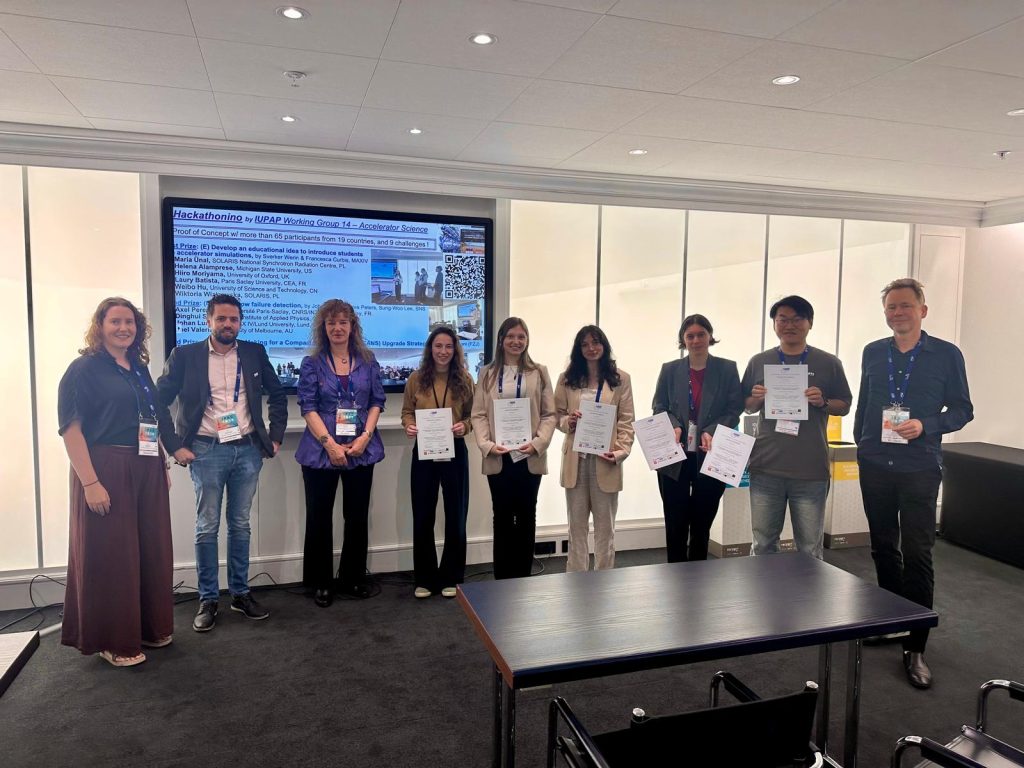 | Challenge B – RF window failure detection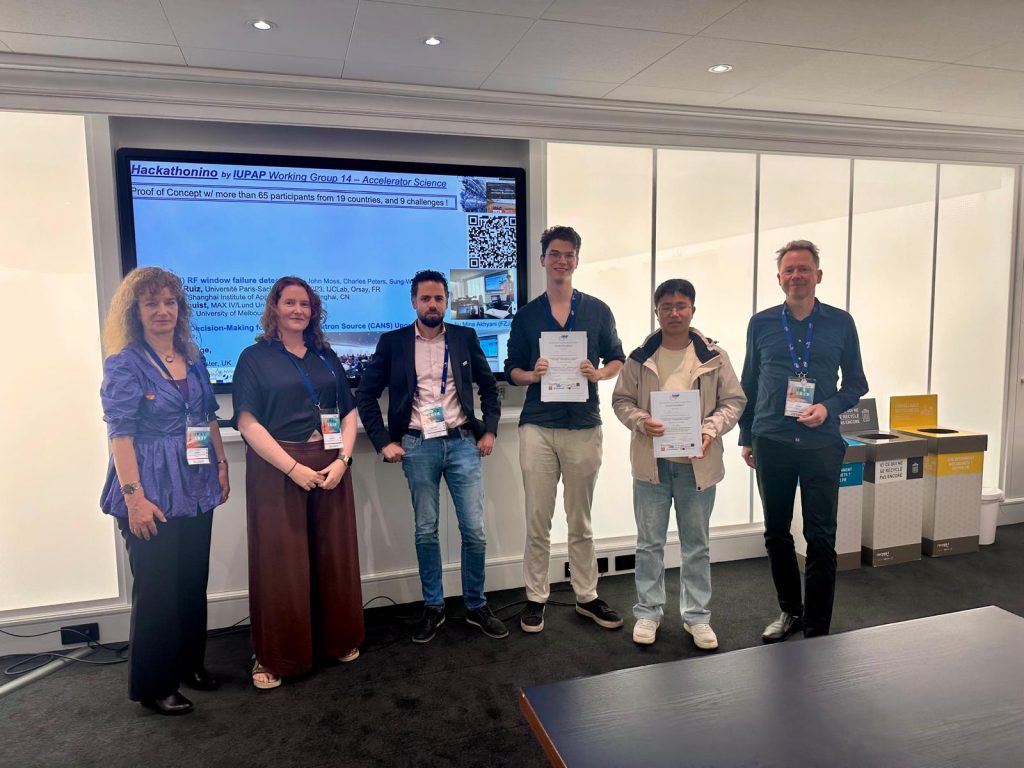 | Challenge F Decision-Making for a Compact Neutron Source (CANS) Upgrade Strategy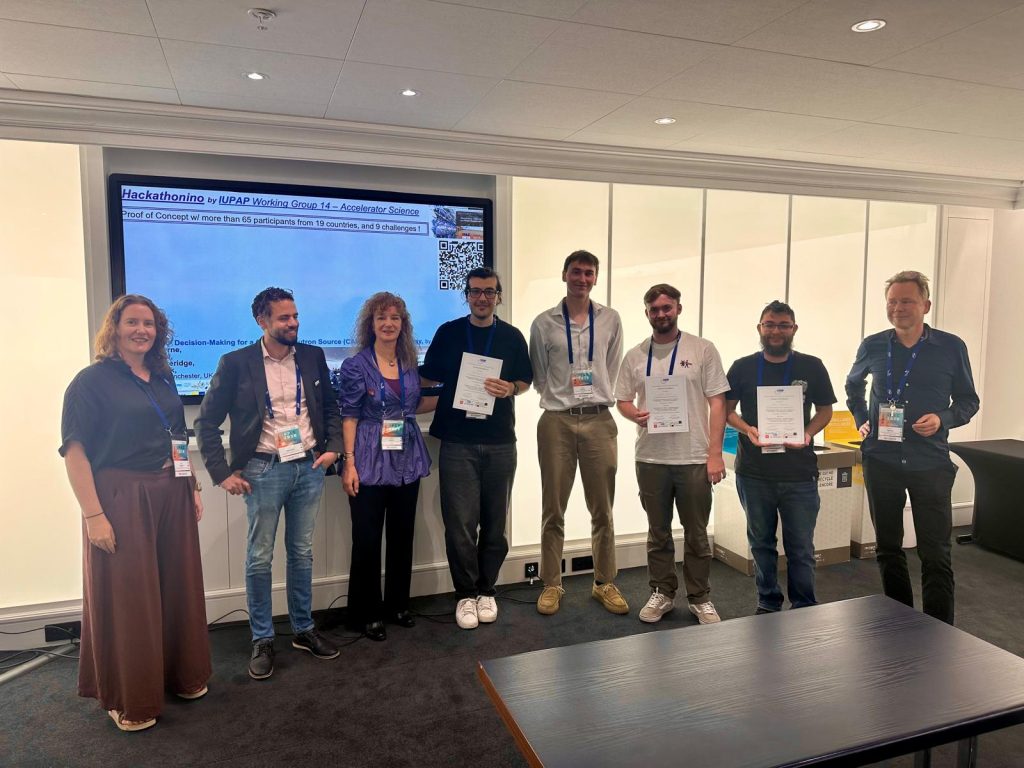 |
The Hackathonino main objective is to foster collaboration between Students, Mentors from Research Infrastructures (Ris) and Companies, by addressing real-world challenges with cutting-edge technologies.
Purpose: A 4-day interactive and engaging (yet light) event at IPAC2026
Participants work closely with researchers and industry mentors, ensuring meaningful learning and engagement. Activities are designed to build:
– Technical problem-solving skills
– Teamwork & collaboration
– Communication & presentation skills
– Insight into accelerator design and professional design tools
Let’s stay tuned for next event..
**** IPAC2026 Indico Page – Here !
“List of Challenges” here
Summary of the 9 challenges at IPAC2026
Roles Descriptions
Each level of engagement is tailored to the interests of the team formed. This event is designed as a fun and collaborative way for students and experts to connect, exchange ideas, and work together.
Students: Although student groups were finalized on Sunday morning, registered participants can begin connecting after the poster session, and information exchange can take place at any time. You were assigned a task that you shaped according to your own interests and strengths. Students were paired with expert mentors for guidance and encouraged to interact with companies. There were no mandatory working hours, but we recommended dedicating time to your project during the scheduled sessions (3–6 pm, Sunday to Tuesday) whenever possible. The overall spirit remained fun, open, and centered on the free exchange of knowledge.
Expert Advisers/Mentors: Once registered, you were contacted based on your profile to support students during the conference. Your level of involvement is flexible and can be adapted to your availability. Online mentors were also accessible during the suggested time slots (3–6 pm, Sunday to Tuesday).
Companies: Students engaged with companies at their booths to explore and work on the proposed challenges. The goal is to foster interactive dialogue, with varying levels of involvement available. Please refer to the main page for further details.
Why companies should also join ?
- Visibility, access to talent, innovation opportunities, and much more.
- More details: Call for Corporate Engagement
Propose your Case Study or Challenge of interest by completing the form. and .doc.
LinkedIn Post —- your help in sharing this with your network would be greatly appreciated !
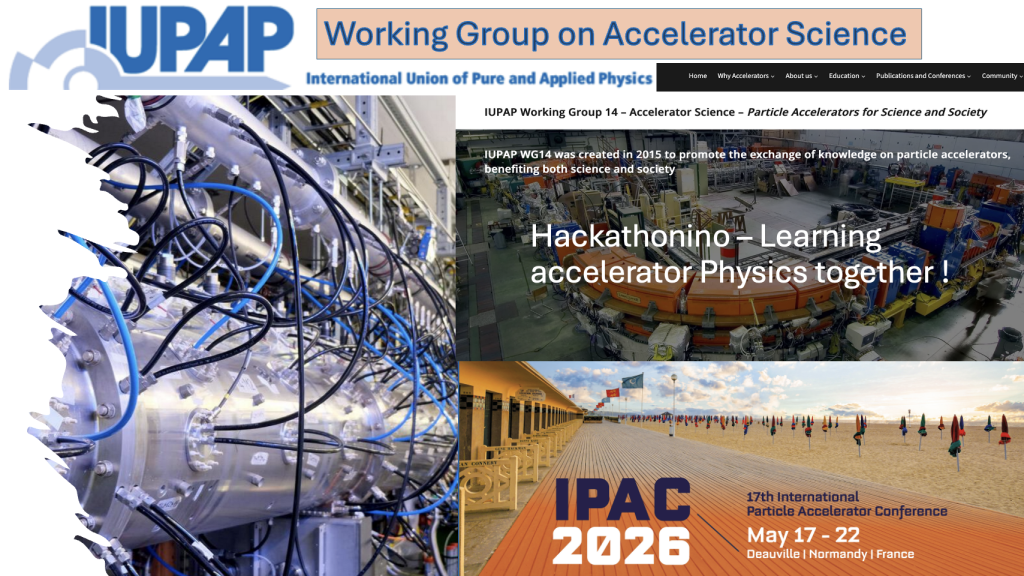
The proposed IUPAP Hackathonino took place during IPAC2026from May 17 to 20, 2026 in Deauville France and served as a proof of concept for an annual event held at IPAC conferences. It builds on IPAC’s unique environment, which already brings together academia and industry, and promote co-creation and innovation around shared industrial and scientific challenges. Organized under IUPAP WG14, with support from Accelerator Science and Technology Industry Permanent Forum (AIPF), Big Science Sweden, CERN, MIT, and others, it has been coordinated closely with the IPAC organizing team.
Around 65 students will form multidisciplinary teams to address societal challenges using accelerator-based concepts and tools. The initiative offered strong impact with modest investment: participants worked on their own laptops, supported by mentoring from accelerator scientists at major research infrastructures and, where possible, industry experts. Over the first three days of IPAC2026, student teams developped and presented their solutions, with several winning teams receiving awards.
Hackathonino focussed on key accelerator-related themes, including, but not limited to, applications in Environment & Materials, Life Sciences, and Energy.
The event has highlighted existing tools while enabling experimentation with datasets from ESS, MAX IV, or CERN and industrial platforms such as ScandiNova, Cosylab, Hopsworks, etc
–> in the meantime, Anyone is welcome to propose a Case Study or Challenge of interest by completing the form. and .doc.
For advanced Users, you can register to the “AISSAI Hackathon on AI for Particle Accelerators” scheduled on October 11-16, 2026 ; MORE DETAILS HERE
References
IPAC Indico page
- Presentation of Hackathonino – DRAFT – 17 Feb 2026
- Call for Corporate Engagement
- Call for Case Study / Challenges. and .doc.
Library by categories (TBC)
- – Controls/ Operations
- – Beam dynamics / Collective Effects
- – Diagnostics
- – RF / LLRF
- – Cryomodule & SRF cavities
- – Magnets / Power converters
- – Vacuum & Cryogenics
- – Test Stands
- – Laser
- – Quantum and beam acceleration
Tools

GitHub: The Colab version together with a version more suitable for a standard Jupyter Notebook environment and a basic manual is available on:
Additional references
- Introduction of Hackathonino (IUPAP – WG14 Meeting#23)
- AISSAI / CNRS
- Group Wiki – Particle and Nuclear Innovation Physics and Particle Solid Interactions in Johannesburg University
- Call for Global Activities – Corporate Engagement (2025)
- Accelerators Engagement Ambassadors Initiative
- “Accelerators key to making our lives better’, says chair of physics union working group”, IUPAP-WG14 @ CERN Accelerating News, Dec. 10, 2025.
- CosyLab – Demo/Features ReqFlow
- I.FAST– and Challenged-based-Innovation (CBI)
- IUPAP-WG14 , incl. ICFA(sustainability)
- AI for Accelerator Technologies– & ARTIFACT
- STELLA project
- EuPRAXIA
- FASEM
- Sunstone (SESAME, ESRF) (Post)
Hopsworks:
Join us and sponsor this initiative !